Showing posts with label Daring Baker's. Show all posts

Saturday, February 28, 2009

Daring Bakers Challenge - Chocolate Valentino Cake

It's the end of another month, and you know what that means...time for another Daring Baker's Challenge. When I first saw the challenge I read "chocolate" and "ice cream", and I immediately knew I was going to love this challenge.

The February 2009 challenge was hosted by Wendy of WMPE's blog and Dharm of Dad ~ Baker & Chef who have chosen a Chocolate Valentino Cake by Chef Wan; a Vanilla Ice Cream recipe from Dharm and a Vanilla Ice Cream recipe from Wendy as the challenge.

We were given an incredible amount of freedom with this challenge. We were able to choose the type of chocolate used for the cake (dark, milk, white, etc.), and we could choose whatever ice cream recipe our little heart desired. I decided to use milk chocolate for the cake, and I made a delicious coffee ice cream.

Where to begin...well let's get started off with the cake recipe:


Chocolate Valentino
Preparation Time: 20 minutes
16 ounces of semisweet chocolate, roughly chopped
½ cup (1 stick) plus 2 tablespoons of unsalted butter
5 large eggs separated

1. Put chocolate and butter in a heatproof bowl and set over a pan of simmering water (the bottom of the bowl should not touch the water) and melt, stirring often.
2. While your chocolate butter mixture is cooling. Butter your pan and line with a parchment circle then butter the parchment.
3. Separate the egg yolks from the egg whites and put into two medium bowls.
4. Whip the egg whites in a medium/large grease free bowl until stiff peaks are formed (do not over-whip or the cake will be dry).
5. With the same beater beat the egg yolks together.
6. Add the egg yolks to the cooled chocolate.
7. Fold in 1/3 of the egg whites into the chocolate mixture and follow with remaining 2/3rds. Fold until no white remains without deflating the batter. {link of folding demonstration}
8. Pour batter into prepared pan, the batter should fill the pan 3/4 of the way full, and bake at 375F (I used a 9in. cake pan and then cut smaller cakes out of it)
9. Bake for 25 minutes until an instant read thermometer reads 140F/60C.
Note – If you do not have an instant read thermometer, the top of the cake will look similar to a brownie and a cake tester will appear wet.
10. Cool cake on a rack for 10 minutes then unmold.
Once my cake was done, I cut out 2 inch circles and squares. I stacked two pieces of cake together and decorated it with chocolate. I either painted on melted chocolate to create a hard chocolate shell, or I used thick chocolate shavings. Add a little powdered sugar, and Oh Yum!
I scream, you scream, we all scream for Ice Cream! Coffee ice cream to be exact. The recipe I used was from Simply Recipes. Check out the recipe here. The cup that is holding the ice cream is made of chocolate too! Since this post is already getting lengthy, check back next week for a post on how to make them.

Remember that this is a "Chocolate Valentine", so I gave my parents and my sister and brother-in-law these yummy cakes for a Valentine treat. I think if I hadn't given away some of the cakes I could have eaten them all! They really were incredibly rich, delicious and down-right decadent!

Thursday, January 29, 2009

Daring Bakers Challenge - Tuiles, Tweels, Toolies, Tulles

Well I'm not sure if I ever learned how to pronounce this months challenge, but let me just start by saying...Chocolate mousse and a crisp cookie. What could be more delectable after a holiday season full of heavy, rich food?! This month's challenge is brought to us by Karen of Bake My Day! and Zorra at 1x unruhren bitte aka Kochtopf. They have chosen Tuiles from the Chocolate Book by Angelique Schmeink and Nougatine and Chocolate Tuiles from Michel Roux.

We were given the option of creating a sweet or a savory tuile. I'll share both recipes with you and then tell you about what I did.

Recipe:
Yields: 20 small cookies/6 large
Preparation time batter 10 minutes, waiting time 30 minutes, baking time: 5-10 minutes per batch

65 grams / ¼ cup / 2.3 ounces softened butter (not melted but soft)
60 grams / ½ cup / 2.1 ounces sifted confectioner’s sugar
1 sachet vanilla sugar (7 grams or substitute with a dash of vanilla extract)
2 large egg whites (slightly whisked with a fork)
65 grams / 1/2 cup / 2.3 ounces sifted all purpose flour
Butter/spray to grease baking sheet

Oven: 180C / 350F

Using a hand whisk or a stand mixer fitted with the paddle (low speed) and cream butter, sugar and vanilla to a paste. Keep stirring while you gradually add the egg whites. Continue to add the flour in small batches and stir to achieve a homogeneous and smooth batter/paste. Be careful to not over mix.

Cover the bowl with plastic wrap and chill in the fridge for at least 30 minutes to firm up. (This batter will keep in the fridge for up to a week, take it out 30 minutes before you plan to use it).

Line a baking sheet with parchment paper or grease with either butter/spray and chill in the fridge for at least 15 minutes. This will help spread the batter more easily if using a stencil/cardboard template such as the butterfly. Press the stencil (I cut out a stencil from a cardboard box) on the baking sheet and use an off sided spatula to spread batter. Leave some room in between your shapes.

Note: Word to the wise, DO NOT underestimate how thin you need to make these cookies! They need to be spread out paper thin in order to become crispy after baking.

Bake cookies in a preheated oven (180C/350F) for about 5-10 minutes or until the edges turn golden brown. Immediately release from baking sheet and proceed to shape/bend the cookies in the desired shape. These cookies have to be shaped when still warm, you might want to bake a small amount at a time or maybe put them in the oven to warm them up again. Or place a baking sheet toward the front of the warm oven, leaving the door half open. The warmth will keep the cookies malleable.

If you don’t want to do stencil shapes, you might want to transfer the batter into a piping bag fitted with a small plain tip. Pipe the desired shapes and bake. Shape immediately after baking using for instance a rolling pin, a broom handle, cups, cones….

Nougatine:
From Michel Roux: Finest Desserts

5.1/4 cups / 500 grams sliced almonds
(or 4.1/3 cups/500 grams slivered almonds)
3.1/3 cups / 660 grams sugar
4 tbs / 60 grams butter (optional)
2 tbs oil (vegetable, sunflower, peanut)

Makes 2.3/4 lbs/1.2 kgs! (This is the yield of the recipe given in the book, feel free to downsize!)
Preparation time: 25 minutes
Preheat oven: 180C/350F

Spread the almonds on a baking sheet and toast in the oven until lightly browned. Cook the sugar in a heavy based saucepan over low heat, stirring gently and continuously with a spatula, until it melts to a light golden caramel. Add the almonds and stir over low heat for 1 minute, then stir in the butter until completely absorbed. (This is not essential, but will give the nougat an added sheen) Pour the nougatine onto an oiled baking sheet.

Shaping: place a baking sheet toward the front of the warm oven, leaving the door half open. The warmth will keep the cookies malleable. Work with one piece at a time, of a size appropriate to the shape you want. Roll out each piece on a warm, lightly oiled baking sheet or lightly oiled marbled surface. It is essential to work quickly, since the nougatine rapidly becomes brittle. Heat the nougatine in a microwave oven for a few seconds only to soften it if needed.

Roll the nougatine into the appropriate thickness for your desired shape, but never thicker than 1/8 inch or 3 mm. Quickly cut out your chosen shapes using cookie cutters, or the blade or heel of a chef’s knife. To mold the nougatine, drape it very rapidly over the mold so that it follows the shape and contours. Leave until completely cold before removing from the mold.
Or, cut out and using your fingers or a knife, push into folds or pleats… use as a basket, twirl round a knitting needle..

Nougatine based shapes can be made two or three days in advance, Keep them in a very dry place and do not fill with something like a mousse more than 2 hours prior to serving.

Chocolate Tuiles
Michel Roux’s Finest Desserts
Makes 30
Preparation time: 15 minutes!

9 oz/250 grams dark or white couverture or best-quality bittersweet chocolate, chopped
2/3 cup/75 gr slivered almonds, toasted and cooled

Temper the couverture, and stir in the toasted almonds. Place the template on a sheet of rodoïde (or use a clean sheet of sturdy plastic such as a folder) and fill with about 1 tbs of the mixture. Repeat the process a little distance away from the first one. As soon as you have 5 tuiles fit, slide them onto a mold or rolling pin (side of a glass) to curve. Let cool completely, lift tuiles off the plastic only after the chocolate has set and just before serving, so that they keep their shine.


Savory tuile/cornet recipe
From Thomas Keller "the French Laundry Cookbook"

1/4 cup plus 3 tablespoons (65 grams/2.1/4 ounces) all purpose flour
1 tablespoon plus 1 teaspoon sugar
1 teaspoon kosher salt (= 2/3 teaspoon table salt)**
8 tablespoons (114 grams/4 ounces) unsalted butter, softened but still cool to the touch
2 large egg whites, cold
2 tablespoons black sesame seeds

In a medium bowl, mix together the flour, sugar and salt. In a separate bowl, whisk the softened butter until it is completely smooth and mayonnaise-like in texture. Using a stiff spatula or spoon, beat the egg whites into the dry ingredients until completely incorporated and smooth. Whisk in the softened butter by thirds, scraping the sides of the bowl as necessary and whisking until the batter is creamy and without any lumps. Transfer the batter to a smaller container, as it will be easier to work with.

Preheat the oven to 400 degrees F.

Make a 4-inch hollow circular stencil. Place Silpat on the counter (it is easier to work on the Silpat before it is put on the sheet pan). Place the stencil in one corner of the sheet and, holding the stencil flat against the Silpat, scoop some of the batter onto the back of an offset spatula and spread it in an even layer over the stencil. Then run the spatula over the entire stencil to remove any excess batter. After baking the first batch of cornets, you will be able to judge the correct thickness. You may need a little more or less batter to adjust the thickness of the cornets.

There should not be any holes in the batter. Lift the stencil and repeat the process to make as many rounds as you have molds or to fill the Silpat, leaving about 1 1/2 inches between the cornets. Sprinkle each cornet with a pinch of black sesame seeds.

Place the Silpat on a heavy baking sheet and bake for 4 to 6 minutes, or until the batter is set and you see it rippling from the heat. The cornets may have browned in some areas, but they will not be evenly browned at this point.

Open the oven door and place the baking sheet on the door. This will help keep the cornets warm as you roll them and prevent them from becoming too stiff to roll. Flip a cornet over on the sheet pan, sesame seed side down and place 4-1/2 inch cornet mold at the bottom of the round. If you are right-handed, you will want the pointed end on your left and the open end on your right. The tip of the mold should touch the lower left edge (at about 7 o'clock on a clock face) of the cornet.

Fold the bottom of the cornet and around the mold; it should remain on the sheet pan as you roll. Leave the cornet wrapped around the mold and continue to roll the cornets around molds; as you proceed, arrange the rolled cornets, seams side down, on the sheet pan so they lean against each other, to prevent from rolling.

When all the cornets are rolled, return them to the oven shelf, close the door, and bake for an additional 3 to 4 minutes to set the seams and color the cornets a golden brown. If the color is uneven, stand the cornets on end for a minute or so more, until the color is even. Remove the cornets from the oven and allow to cool just slightly, 30 seconds or so.
Gently remove the cornets from the molds and cool for several minutes on paper towels. Remove the Silpat from the baking sheet, wipe the excess butter from it, and allow it to cool down before spreading the next batch. Store the cornets for up to 2 days (for maximum flavor) in an airtight container.


My hubby and I both have a sweet tooth, so the sweet crispy tuile was a no-brainer. I made a round stencil that was about 4 inches in diameter. I also made a heart shaped stencil (Valentine's is just around the corner ;)). The cookies can be molded around just about anything. The rounds I molded around a highlighter. Who knew you could mix office supplies with baking!

Once the cookies were made I needed something light and fluffy to accompany them...mousse! Here's a variation of a recipe from Simply Recipes:

Chocolate Mousse:
3 tablespoons cocoa powder
3 tablespoons (1 ounce) unsalted butter, diced
1 cup cold heavy cream
3 large eggs, separated
1 tablespoon sugar

1 Whip the cream to soft peaks, then refrigerate.

2 Combine the chocolate, butter, and espresso in the top of a double boiler over hot, but not simmering, water, stirring frequently until smooth. Remove from the heat and let cool until the chocolate is just slightly warmer than body temperature. To test, dab some chocolate on your bottom lip. It should feel warm. If it is too cool, the mixture will seize when the other ingredients are added.

3 Once the melted chocolate has cooled slightly, whip the egg whites in a medium bowl until they are foamy and beginning to hold a shape. Sprinkle in the sugar and beat until soft peaks form.

4 When the chocolate has reached the proper temperature, stir in the yolks. Gently stir in about one-third of the whipped cream. Fold in half the whites just until incorporated, then fold in the remaining whites, and finally the remaining whipped cream.

5 Spoon or pipe the mousse into a serving bowl or individual dishes. If you wish, layer in fresh raspberries and whipped cream. Refrigerate for at least 8 hours. (The mousse can be refrigerated for up to a day.)

Using a frosting tip, I fill each cookie with the mousse. The rest of the mousse I piped into a glass cup to accompany my tuile hearts. Although the result wasn't my prettiest creation, it was very delicious.

Sunday, November 30, 2008

Daring Baker's Challenge - Caramel Cake and a Sugar High

Well friends, I successfully finished my second Daring Baker's Challenge. I was thrilled when I found out the challenge was Carmel Cake because of my love of anything caramel, and because it would be a perfect surprise for my Dad's birthday which was in November. If you can't stand the thought of eating another dessert after the smorgasbord of food consumed over Thanksgiving, then make the cake and give it to a friend just so you can experience the delicious smell of browned butter and caramel that fills your home. Thank you to our fabulous hosts for November's challenge: Dolores, Alex and Jenny .
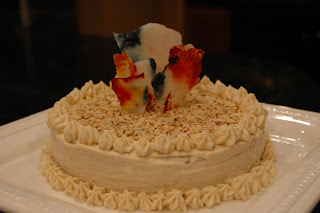
The original recipe comes from Shuna Fish Lyndon. We were given quite a bit of freedom with the recipe, so I decided to make a layered 9 inch cake. I had also been warned about the sweetness level of this cake, so I made some alterations such as cutting down on the sugar content and adding salt.

The first step is to make the caramel. You'll end up having extra caramel left over, so you can use it for other tasty treats or use it to sweeten your morning tea.
Caramel Syrup:
-2 cups sugar
-1/2 cup water
-1 cup water (for "stopping" the caramelization process)

-In a small stainless steel saucepan, with tall sides, mix water and sugar until mixture feels like wet sand.
-Brush down any stray sugar crystals with wet pastry brush.
-Turn on heat to highest flame.

-Cook until smoking slightly: dark amber. (Boil about 6-7 minutes. Once you see a slight change of color, pay close attention because the sugar can burn very easily. I burnt my first batch by trying to reach too dark of a color. However, a darker colored caramel syrup will help cut the sweetness factor is the end product.)

-When color is achieved, very carefully pour in one cup of water. Caramel will jump and sputter about! It is very dangerous, so have long sleeves on and be prepared to step back. (I put a piece of foil with a hole in the middle over the saucepan to prevent any caramel from jumping out. this worked very well.)

-Whisk over medium heat until it has reduced slightly and feels sticky between two fingers. (The consistency should be like maple syrup.) {Obviously wait for it to cool on a spoon before touching it.}
Caramel Cake with Caramelized Butter Frosting:
-10 Tablespoons unsalted butter at room temperature
-1 1/4 Cups granulated sugar
-1/2 teaspoon kosher salt
-1/3 Cup Caramel Syrup (see recipe above)
-2 each eggs, at room temperature
-splash vanilla extract
-2 Cups all-purpose flour
-1/2 teaspoon baking powder
-1 cup milk, at room temperature

-Preheat oven to 350F

-Butter one tall (2 – 2.5 inch deep) 9-inch cake pan. (I used 2 9-inch cake pans, and divided the batter between the two pans.)

-In the bowl of a stand mixer fitted with a paddle attachment, cream butter until smooth.

-Add sugar and salt & cream until light and fluffy.

-Slowly pour room temperature caramel syrup into bowl.

-Scrape down bowl and increase speed.

-Add eggs/vanilla extract a little at a time, mixing well after each addition.
-Scrape down bowl again, beat mixture until light and uniform.

-Sift flour and baking powder.
-Turn mixer to lowest speed, and add one third of the dry ingredients.

-When incorporated, add half of the milk, a little at a time.
-Add another third of the dry ingredients, then the other half of the milk and finish with the dry ingredients. {This is called the dry, wet, dry, wet, dry method in cake making. It is often employed when there is a high proportion of liquid in the batter.}
-Take off mixer and by hand, use a spatula to do a few last folds, making sure batter is uniform.

-Turn batter into prepared cake pan. (if using two 9-inch pans, fill each half full.)

-Place cake pan on cookie sheet or 1/2 sheet pan.
-Set first timer for 30 minutes, rotate pan and set timer for another 15-20 minutes. Your own oven will set the pace. Bake until sides pull away from the pan and skewer inserted in middle comes out clean. (If using two 9-inch pans, cook for about 25 minutes.)

-Cool cake completely before icing it.
-Cake will keep for three days outside of the refrigerator.

Caramelized Butter Frosting:
-12 Tablespoons unsalted butter
-1 pound confectioner’s sugar, sifted (I cut this down to 3 cups.)
-4-6 tablespoons heavy cream
-2 teaspoons vanilla extract
-2-4 tablespoons caramel syrup (see recipe above)
-Kosher or sea salt to taste (Start with 1/2 tsp. and add to your desired taste)
-Cook butter until brown. (Browning the butter will cut down on the sweetness factor, and adds a flavor that is incredibly delicious!)
-Pour through a fine meshed sieve into a heatproof bowl, set aside to cool.
-Pour cooled brown butter into mixer bowl.
-In a stand mixer fitted with a paddle or whisk attachment, add confectioner's sugar a little at a time.
-When mixture looks too chunky to take any more, add a bit of cream and or caramel syrup.
Repeat until mixture looks smooth and all confectioner's sugar has been incorporated.

-Add salt to taste.
Note: Caramelized butter frosting will keep in fridge for up to a month. To smooth out from cold, microwave a bit, then mix with paddle attachment until smooth and light.

To assemble, place one layer of the cake on a cake stand. Drizzle with caramel syrup and place second cake on top. Smooth a thin layer of frosting over entire cake. Spread crushed almonds or pecans on top of cake, and decorate edges using a pastry bag and your favorite tip. Sprinkle a small amount of sea salt on top of nuts (the pairing of the savory salt with the sweet cake is a great combination). I placed the cake in the fridge and pulled it out just before serving. The result was a dense, cool cake that everyone loved.

As I mentioned earlier, I made this cake for my Dad's birthday so I wanted to add an unexpected punch of color as a topper on the cake. Since so much of this cake is about playing with sugar, I decided to make Stained Glass Caramel from Tartelette to continue the sugar fun.

Stained Glass Caramel Windows:
-1 cup sugar
-2 1/2 Tb water
-various food colorings

-Line a baking sheet with parchment paper.
-Drop a few drops of food coloring onto the paper. Do not touch them, swirl them or move them.
-In a heavy saucepan, combine the sugar and water, do not stir and bring to a boil over high heat.

-Continue to boil until the caramel reaches the soft crack stage or 140C - 285F on a candy thermometer (do not let it turn color).

-Immediately pour over the parchment paper with the food coloring.

-Take the baking sheet with your hands and move it left to right, right to left to move and swirl the colors.

-Let set until completely cooled. Break pieces of your desired size to decorate the cake with. The stained glass adds a fun structural element to the cake. Overall, it was a hit and every last bit of browned butter goodness was gobbled up!

Wednesday, October 29, 2008

Daring Bakers Challenge - Pizza, Pizza!

This month I took on a new challenge and joined the Daring Bakers. It's an online group that takes on a baking challenge each month. The rules are simple: follow the original recipe given to you, add your own creative twist, keep the challenge ultra top secret, and most of all have fun! For more info on this group check out there website here: The Daring Bakers.
Now for the challenge: This month we were asked to bake a simple pizza crust. We had to use a sauce of some kind, but the rest of the toppings were up to our imagination.
Oh yeah, they also told us we had to toss the dough and capture a picture of it. I quickly found that tossing wasn't my forte, but I sure had fun doing it. (Thanks Michelle for taking the picture! :))

Savory Pizza

The Dough: I'll have to get back to you with a link to the recipe. For one pizza crust I stuffed it with a tablespoon of basil and a small handful of sun dried tomatoes. This was a hit!

As promised, here is the recipe:

~ BASIC PIZZA DOUGH ~

Original recipe taken from “The Bread Baker’s Apprentice” by Peter Reinhart.

Makes 6 pizza crusts (about 9-12 inches/23-30 cm in diameter).

Ingredients: 4 1/2 Cups (20 1/4 ounces/607.5 g) Unbleached high-gluten (%14) bread flour or all purpose flour, chilled

1 3/4 Tsp Salt1 Tsp Instant yeast

1/4 Cup (2 ounces/60g) Olive oil or vegetable oil

1 3/4 Cups (14 ounces/420g or 420ml)

Water, ice cold (40° F/4.5° C)

1 Tb sugar Cornmeal for dusting

DAY ONE 1. Mix together the flour, salt and instant yeast in a big bowl (or in the bowl of your stand mixer).

2. Add the oil, sugar and cold water and mix well (with the help of a large wooden spoon or with the paddle attachment, on low speed) in order to form a sticky ball of dough. On a clean surface, knead for about 5-7 minutes, until the dough is smooth and the ingredients are homogeneously distributed. If it is too wet, add a little flour (not too much, though) and if it is too dry add 1 or 2 teaspoons extra water.NOTE: If you are using an electric mixer, switch to the dough hook and mix on medium speed for the same amount of time.The dough should clear the sides of the bowl but stick to the bottom of the bowl. If the dough is too wet, sprinkle in a little more flour, so that it clears the sides. If, on the contrary, it clears the bottom of the bowl, dribble in a teaspoon or two of cold water.The finished dough should be springy, elastic, and sticky, not just tacky, and register 50°-55° F/10°-13° C.

3. Flour a work surface or counter. Line a jelly pan with baking paper/parchment. Lightly oil the paper.

4. With the help of a metal or plastic dough scraper, cut the dough into 6 equal pieces (or larger if you want to make larger pizzas).NOTE: To avoid the dough from sticking to the scraper, dip the scraper into water between cuts.

5. Sprinkle some flour over the dough. Make sure your hands are dry and then flour them. Gently round each piece into a ball.NOTE: If the dough sticks to your hands, then dip your hands into the flour again.

6. Transfer the dough balls to the lined jelly pan and mist them generously with spray oil. Slip the pan into plastic bag or enclose in plastic food wrap.

7. Put the pan into the refrigerator and let the dough rest overnight or for up to thee days.NOTE: You can store the dough balls in a zippered freezer bag if you want to save some of the dough for any future baking. In that case, pour some oil(a few tablespooons only) in a medium bowl and dip each dough ball into the oil, so that it is completely covered in oil. Then put each ball into a separate bag. Store the bags in the freezer for no longer than 3 months. The day before you plan to make pizza, remember to transfer the dough balls from the freezer to the refrigerator.

DAY TWO 8. On the day you plan to eat pizza, exactly 2 hours before you make it, remove the desired number of dough balls from the refrigerator. Dust the counter with flour and spray lightly with oil. Place the dough balls on a floured surface and sprinkle them with flour. Dust your hands with flour and delicately press the dough into disks about 1/2 inch/1.3 cm thick and 5 inches/12.7 cm in diameter. Sprinkle with flour and mist with oil. Loosely cover the dough rounds with plastic wrap and then allow to rest for 2 hours.

9. At least 45 minutes before making the pizza, place a baking stone on the lower third of the oven. Preheat the oven as hot as possible (500° F/260° C). NOTE: If you do not have a baking stone, then use the back of a jelly pan. Do not preheat the pan.

10. Generously sprinkle the back of a jelly pan with semolina/durum flour or cornmeal. Flour your hands (palms, backs and knuckles). Take 1 piece of dough by lifting it with a pastry scraper. Lay the dough across your fists in a very delicate way and carefully stretch it by bouncing it in a circular motion on your hands, and by giving it a little stretch with each bounce. Once the dough has expanded outward, move to a full toss.NOTE: Make only one pizza at a time.During the tossing process, if the dough tends to stick to your hands, lay it down on the floured counter and reflour your hands, then continue the tossing and shaping. In case you would be having trouble tossing the dough or if the dough never wants to expand and always springs back, let it rest for approximately 5-20 minutes in order for the gluten to relax fully,then try again.You can also resort to using a rolling pin, although it isn’t as effective as the toss method.

11. When the dough has the shape you want (about 9-12 inches/23-30 cm in diameter - for a 6 ounces/180g piece of dough), place it on the back of the jelly pan, making sure there is enough semolina/durum flour or cornmeal to allow it to slide and not stick to the pan.

12. Lightly top it with sweet or savory toppings of your choice.NOTE: Remember that the best pizzas are topped not too generously. No more than 3 or 4 toppings (including sauce and cheese) are sufficient.

13. Slide the garnished pizza onto the stone in the oven or bake directly on the jelly pan. Close the door and bake for abour 5-8 minutes.NOTE: After 2 minutes baking, take a peek. For an even baking, rotate 180°.If the top gets done before the bottom, you will need to move the stone or jelly pane to a lower shelf before the next round. On the contrary, if the bottom crisps before the cheese caramelizes, then you will need to raise the stone or jelly.

14. Take the pizza out of the oven and transfer it to a cutting board or your plate. In order to allow the cheese to set a little, wait 3-5 minutes before slicing or serving.


The Sauce: Mix pesto and Alfredo sauce and spread over the dough. This gave the pizza a rich, creamy base.
The Toppings: Arrange pulled cooked chicken and thinly sliced onion. I added variety by adding thinly sliced red bell peppers, sun dried tomatoes or basil. Top the pizza with a generous handful of mozzarella cheese, and sprinkle with salt and pepper.


Sweet Pizza
The Dough: Same as the savory recipe
The Sauce: 2 T. melted butter, 2 tsp. cinnamon. Mix and spread over crust
The Toppings: 3/4 c. brown sugar, 3/4 c. flour, 1 T. water, 1/4 c. softened butter, about 1 tsp. cinnamon, 1/3 c. oatmeal, 1/3 c. crushed almonds, thinly sliced strawberries. Set the strawberries aside, and mix all ingredients together. Add oatmeal as needed to get a crumbly texture. Sprinkle over the crust. Layer with sliced strawberries.
For an extra sweet touch: Mix 1/2 c. confectioner's sugar, 1/2 T. milk and 1/8 tsp. vanilla. Swirl the glaze on top of the pizza.
Note: It will smell delicious the second it comes out of the oven, but swat those hungry hands away because it tastes best once it has had time to cool down a bit.

Between the pizza, wine and good friends to share it with...a girl couldn't ask for much more!